Unlocking the hidden language of heat for smarter sleep and training
Heat is your most honest performance metric. It tells the truth about your body, before your heart rate or steps do. Learn to read your thermal rhythm, and you'll know when to push, when to pace, and when to sleep.
Jan 6, 2026
Why most wearables miss the real signal
Most wearables track motion and heart rate. Helpful? Yes. Complete? No. They rarely capture how heat moves through your body (core → skin → environment) or how efficiently you cool, which are the early signals of strain and recovery. Without thermal context, energy and recovery scores can mislead.
Heat is foundational to sleep and performance
Sleep onset isn't random. It is triggered by a temperature shift. This core-to-limb gradient signals your brain that it's time to rest and is a strong predictor of how quickly you'll fall asleep.
During exercise, your core temperature rises before your heart rate spikes. If you miss that signal, you risk fatigue and dehydration. Muscle fatigue leaves thermal fingerprints. Infrared imaging studies show that temperature patterns reveal which muscles are working hardest and where imbalances exist, key for injury prevention.1
"Motion ≠ readiness. Your cooling efficiency tells you what your heart rate can't."
What heat awareness unlocks
- Readiness & strain: Act before the drop
Thermal strategies improve endurance before your legs know it. When your core temperature climbs and cooling lags, strain is building, even if your heart rate looks fine. Acting early (slowing pace, adding airflow, hydrating) prevents performance crashes. Recent studies show heat adaptation reduces strain and improves performance, with longer acclimation periods delivering even greater benefits.2
- Power peaks & muscle balance: Train where it matters
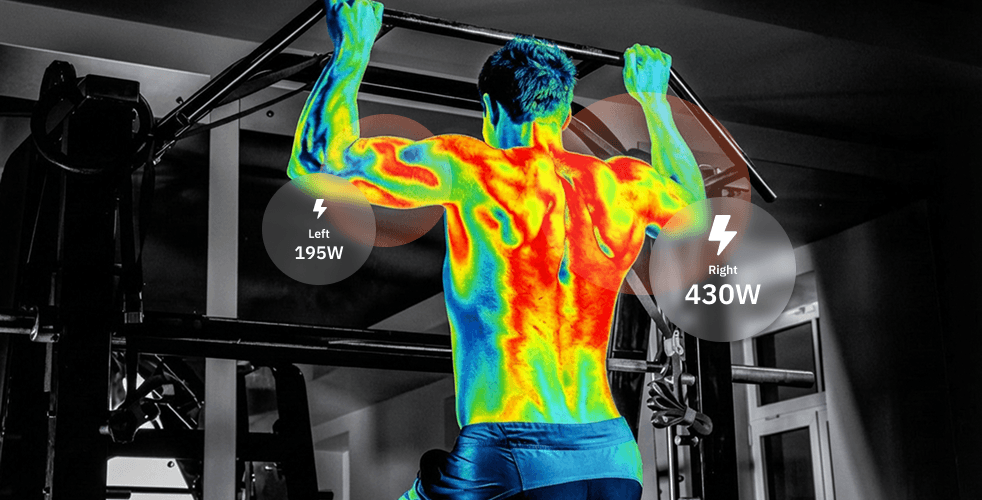
Thermal mapping reveals which muscles are overworking during activity. If your left quad runs hotter than your right, it's a clear sign of imbalance in muscle engagement. Address this early to prevent it from developing into a potential injury.
"Your heat map is your coach. Spot the imbalance before it sidelines you."
- Nighttime recovery: Find your real sleep window
At night, your body cools at the core while warming your hands and feet, a process called the distal-proximal gradient. This shift signals your brain to enter deep, restorative Non-Rapid Eye Movement (NREM) sleep. Tracking these thermal patterns explains why some nights feel refreshing and others don't.
Research shows that this gradient isn't just a signal. It's the strongest predictor of how quickly you'll fall asleep, even more than heart rate or melatonin levels. That's because warming your hands and feet promotes heat loss through selective vasodilation, helping your body transition smoothly into sleep.3
Circadian science further shows your body's master clock (SCN) coordinates temperature, sleep, and hormones, and aligning activity with your personal thermal rhythms supports energy, focus, and recovery.4
"Warm the hands, cool the core. Unlock more restful sleep and wake sharper."
Larcz translates heat into simple guidance
If heat is the hidden language of your body, Larcz is the translator. It's the first dual-zone wearable system designed for both sleep and performance. Two small, durable, water-resistant pods (one near your core and one on a limb) measure what really matters: skin and core temperature, ambient temperature, movement, stress signals (electrodermal activity), and even heart rate and oxygen levels.
Larcz takes these signals and visualizes your body's heat flow, cooling efficiency, muscle-specific output, and circadian windows, then turns them into simple, actionable guidance you can act on:
- Core-to-limb temperature gradients: Reveal when your body is primed for peak performance and when it needs recovery.
- Heat flow analysis: Offers cooling efficiency insights so you can adjust intensity before fatigue sets in.
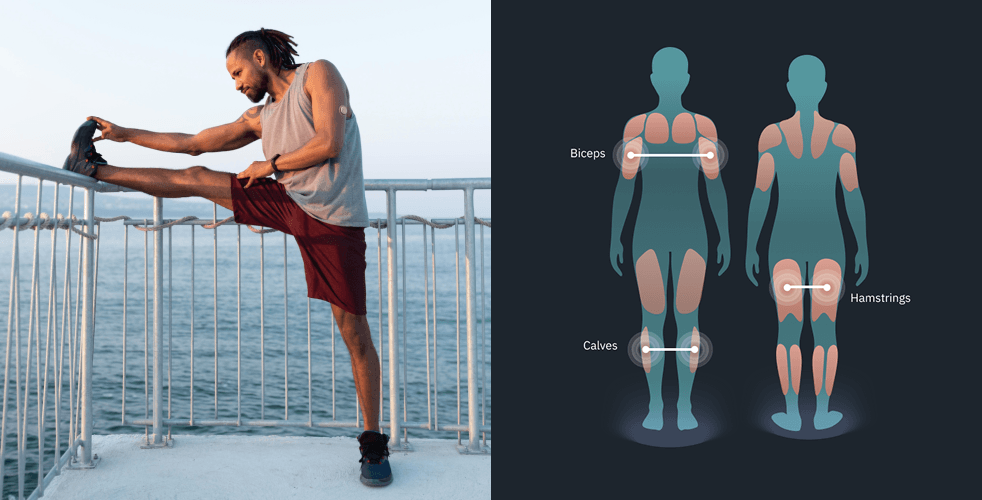
- Localized muscle heat mapping: Highlights imbalances that could lead to injury.
- Night-time thermal signatures: Detect any thermoregulatory issues affecting your sleep.
All of this comes in a comfortable, discreet design that feels like a second skin so you can harness the hidden language of heat without changing your routine.
"If you can see heat, you can time your day."
Your edge starts here
See cooling efficiency, muscle power, and your circadian sleep window, all in one system. Get early access now.
References:
-
Ridzuan, N., et al. "Muscle Fatigue Evaluation Using Non-invasive Infrared Thermography Technique With Assisted Electromyography: A Preliminary Study." International Medical Device and Technology Conference, 2017.
-
Alhadad, Sharifah Badriyah, et al. "Efficacy of Heat Mitigation Strategies on Core Temperature and Endurance Exercise: A Meta-Analysis." Frontiers in Physiology, vol. 10, 13 Feb. 2019, https://doi.org/10.3389/fphys.2019.00071
-
Krauchi, Kurt, et al. "Functional Link between Distal Vasodilation and Sleep-Onset Latency?" American Journal of Physiology-Regulatory, Integrative and Comparative Physiology, vol. 278, no. 3, 2000, pp. R741-R748, https://doi.org/10.1152/ajpregu.2000.278.3.R741
-
National Institute of General Medical Sciences. "Circadian Rhythms." NIGMS, U.S. Department of Health and Human Services, 1 June 2025, www.nigms.nih.gov/education/fact-sheets/Pages/circadian-rhythms.aspx